

Covid vaccine mandates don’t have to undermine your rights
- Safura Abdool Karim
While South Africa has steered clear of compulsory vaccination for now, the country’s laws do allow such a policy.
Th. are definitely doing it. The question is: should we be doing it? The South African government says it won鈥檛 make COVID vaccinations compulsory for its employees for now 鈥� but that .
According to Health Minister Joe Phaahla, the health department will issue , which businesses will be able to use to restrict access to venues based on people鈥檚 vaccination status.
Yet hesitancy may be a significant barrier to the success of South Africa鈥檚 vaccine programme 鈥� a survey by the Human Sciences Research Council in June and July this year showed that .
With the aim of getting , introducing official policies to allow for mandatory COVID-19 vaccination is one way of getting more people vaccinated. Such policies are called vaccine mandates.
Countries such as , have, for instance, introduced mandatory vaccinations for health workers and certain government workers. And in the United States, President Joe Biden announced a plan that will require or show a negative COVID test once a week before coming to work.
The raging question for South Africa is not so much about whether the government should consider a COVID-19 vaccine mandate, but rather whether they can. And the short answer is yes.
Leveraging the law: How to mandate vaccines
The government could call on two laws that would allow them to make getting a COVID-19 vaccine compulsory, if it ever came to that.
In 2020, under the , which have long been in place and are updated from time to time. A notifiable condition is because it can lead to outbreaks that are fatal or severely affect many people. Examples of notifiable diseases in South Africa are cholera, listeriosis and tuberculosis.
Every doctor or nurse in both the public and private health sector who diagnoses a patient with a notifiable condition has to report it to the National Institute of Communicable Diseases 鈥� failure to do so is a criminal offense.
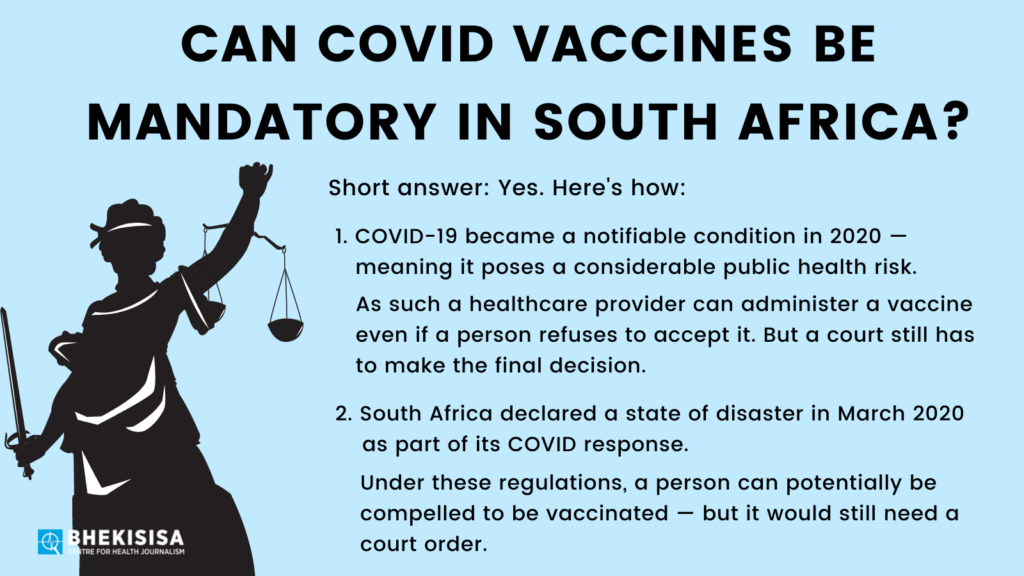
Under the Notifiable Medical Conditions Regulations, a healthcare provider would be allowed to administer a vaccine even if a person refuses to accept it. But this is not as totalitarian as it sounds: a court has to decide whether this would be a justified action. The process is complicated, because the head of the provincial department of health would have to apply for a court order and then the court must assess 鈥� on a case-by-case basis 鈥� whether compelling the person to take a vaccine without their consent is justified.
Another route that could be used to justify mandatory vaccination is the , which are used to regulate South Africa鈥檚 COVID-19 response. Under these regulations, a person can be compelled to undergo COVID-19 testing, isolate if infected 鈥� and potentially also be vaccinated. It would still have to be a court order, but the process is slightly easier as such an application can be lodged by people from a wider range of sectors 鈥� for example, healthcare workers, government officials or certain ranks of police officers 鈥� and the order can be granted by a magistrate鈥檚 court.
Both these avenues have been used in the past to institute or even for conditions that pose a significant public health risk. But in the context of making COVID-19 vaccination compulsory, they are unlikely to be feasible options.
Keeping our options open: How to incentivise mass vaccination
When authorities look to introduce vaccine mandates, they generally try to incentivise people to get vaccinated. This means being vaccinated can be a requirement to do certain things, while non-adherence may result in some form of penalty.
For example, now requires that government workers either be vaccinated or submit to weekly testing. The City of New York also recently instituted the 鈥� a pass granting people access to indoor activities such as restaurants, performances and gyms provided they have been vaccinated against COVID-19. The use of similar vaccination certificates has recently also been announced in , the and .
The practice is not new, and South Africa already has some mandates in place to encourage specific vaccinations.
For example, the department of basic education requires parents to submit their child鈥檚 immunisation card , to prove that the child has been vaccinated against vaccine-preventable childhood diseases such as measles, polio and whooping cough. Although admission currently cannot be refused if a child is not vaccinated, the department is that would prevent unvaccinated children from being admitted to public schools.
Another example is the , which was instituted in line with the World Health Organisation鈥檚 . Anyone who wants to travel to an area with a high risk of yellow fever must prove that they have been vaccinated against the disease before being allowed to enter that country or to re-enter South Africa. Those who do not want to be vaccinated are not forced to take a vaccine, but are prohibited from travelling.
To vax or not? Workplaces may not give you the option
Internationally, a number of private companies are moving towards making COVID-19 vaccines mandatory for their employees, and South Africa is already following suit.
On 2 September 2021, Discovery announced that from 1 January 2022. Adrian Gore, CEO of Discovery, explained that the decision was motivated by to provide a safe working environment for their employees. Since Discovery鈥檚 announcement, a number of other organisations, including and private companies, have implemented similar policies, or are considering them.
Most private companies introducing these policies are relying on the , which requires employers to provide a working environment that is safe and without a health risk. The department of labour also for employees who are at high risk for developing severe COVID-19 or at a high risk to transmit SARS-CoV-2, the virus that causes COVID-19.
The Constitution vs COVID: A balancing act of rights
Some legal commentary argues that making the COVID-19 vaccine compulsory , including the rights to bodily integrity, freedom of religion, and dignity. And although it is true that mandatory vaccination may limit these rights, it is important to recognise the flip side: no constitutional right is absolute.
This means that any right in the bill of rights can be limited if justified under section 36 of the Constitution. For example, if the prosecution needs an accused鈥檚 blood as evidence to support their case, the person鈥檚 right to bodily integrity can be limited and he or she can be compelled to have a blood sample drawn.
What has also often been overlooked in citing individual rights in the argument against mandatory vaccination is that the courts have found far-reaching limitations to be justifiable during the COVID-19 pandemic. For example, the High Court in Pretoria found that was a justifiable limitation of the right to freedom of religion. The argument was that the measure would assist in controlling the pandemic, and the court specifically recognised the concept of ubuntu 鈥� calling on citizens to make sacrifices to their individual rights for 鈥渢he greater good鈥� of curbing the pandemic.
Similarly, the Supreme Court of Appeal recognised the 鈥渢rade-off鈥� between individual liberties and curbing the spread of COVID-19 in a judgment that found the . The ruling came down to the court saying that limiting individual liberties such as the right to freedom of movement and the right to dignity was justified because it protects the right to life of people who may otherwise have been vulnerable to dying from COVID-19.
Responsibility and rights: A legal roadmap for vaccine mandates
Although the law allows for potential mandatory COVID-19 vaccination in South Africa, what this looks like in practice will depend not only on the government but also on the private sector. Arguably, vaccines are more invasive than closing mosques or preventing the sale of alcohol. And as there are no specific cases testing the constitutionality of vaccine mandates, prior court rulings can provide only a guide to the approach.
The complex, multilayered practicalities of enforcing COVID-19 vaccination mean that vaccine mandates will have to be developed responsibly. In some contexts, such as frontline healthcare, a hardline approach may be warranted and the limitation of individual rights could be justified.
But it might not apply in all contexts. Some individuals may have valid, medical reasons for not being able to take a COVID-19 vaccine; others may be objecting on religious grounds or work in low-risk environments where their decision not to be vaccinated poses little risk to others. Outside of work environments, vaccine mandates could be used to incentivise rather than enforce vaccination, without significant incursions on individual rights.
In the end, decisions about mandatory COVID-19 vaccination may ultimately be informed by our individual actions. Because with every right also comes a responsibility.
Safura Abdool Karim is a public health lawyer at the 91看片网 (91看片网). She also consults for a health policy research unit funded by the South African Medical Research Council and 91看片网, the Centre for Health Economics and Decision Science (Priceless).