

Independence is at the heart of the African Development Bank’s ability to be effective
- Kalu Ojah
There is concern over the growing influence of non-regional players in decision making at the regional bank.
Independence is a cardinal pillar for organisations that are set up to deliver a public good. Their success depends on it.
This is particularly true of development banks such as African Development Bank, and . Independence is even more important in these instances because these institutions are owned by 鈥� and are meant to cater for 鈥� numerous regional member states.
In my view their ability to deliver on the objective of assisting member states attain economic growth and sustainable development is inexorably dependent on their independence. By this I mean their capacity to focus productively on their goals and missions without external sway.
There are two aspects to this independence. The first is objective independence. This talks to how the institution is set up, who has shares in it and the like. Regional development banks typically get shareholder contributions of capital (which determines country shareholdings). They then go to capital markets to borrow multiples of their capital base (money from shareholders). Objective independence depends on shareholder contributions.
The second aspect of independence is implicit independence. This talks to the ability of the bank to borrow from capital markets. The reputation of the bank is key to its ability to mobilise capital to pursue bold development plans.
The AfDB is one of four main regional banks of the world. The other three are the , and .
Objective indepedence
Objective independence is conventionally reflected in the distribution of capital contribution (ownership share subscription) of member states. This speaks to voting rights and associated board of governors鈥� and directors鈥� compositions.
This aspect of the bank independence gives details of the governance architecture around decision making and the day-to-day running of the bank. The bank president and board of directors 鈥� appointed by a board of governors 鈥� are mandated to implement decisions and run the daily affairs of the bank.
It is in this aspect of bank independence that non-regional member states are typically invited to foster transparency of governance, inject diversity, and enrich board decisions with global best practice. These are often governments or organisations invited from developed, well-performing or geographically representative countries.
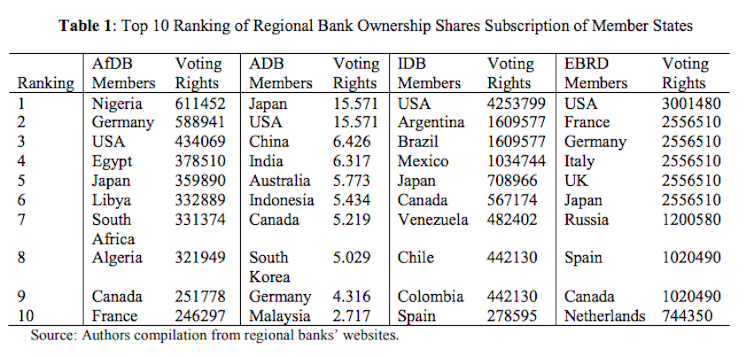
All four of the world鈥檚 biggest regional development banks have explored the benefit of non-regional member states.
But the AfDB falls short on this score. This is because non-regional members dominate the top capital contributors of the bank鈥檚 capital base. This 鈥渓eague table鈥� ranking typically reflects the voting rights accorded member states. And unlike the other regional banks, three of the top five capital contributors in AfDB are non-African states. And 50% or more of the top 10 contributors are also non-African states.
One, therefore, has to ask where are Kenya, Ghana, Morocco, Ethiopia, Cote-d鈥橧voire, Tunisia, Senegal, Angola 鈥� and others 鈥� in response to the vital imperative of ensuring their regional bank鈥檚 independence? This list is of countries that could be, but are not, among the top capital contributors to AfDB鈥檚 ownership and capital base.
These kinds of skewed voting rights put a dangerously destabilising power in the hands of a non-regional member who at any time may get the itch for autocracy. This was recently when the US brashly attempted to veto a corporate governance guided decision of the bank鈥檚 board, mainly by virtue of its relative voting right.
This kind of possibility clearly compromises the independence of the bank.
Sensibly, this should have been anticipated. A carefully nuanced structuring of board powers should have been put in place, with checks against such a likelihood. Such a balancing act would also have endeavoured to imbue regional member states with some 鈥減ower of insistence鈥� on determining their collective goals and mission.
That said, regional member states鈥� contribution heft, still remains the best path to ensuring robustness of this aspect of bank independence.
Implicit independence
Implicit independence is reflected in the capacity (reputation) of the bank to mobilise substantial capital, usually in multiples of its capital base, for prosecuting grand development agendas of the region that need huge capital outlay.
Until recently, this had evidently not been explored by the African Development Bank.
This capacity is usually flagged by two factors. Firstly, conceiving and articulating a well-thought out development agenda. Secondly, the extent of the bonding role provided by non-regional developed country member states, whose capital markets or partnering development organisations may be sources of this primary capital raising.
The record on this source of bank independence has been significantly brightened under the current leadership of the bank headed by Dr Akinwunmi Adesina. Starting in 2018, the bank set itself the ambitious goal of mobilising substantial capital to support development projects of its regional member states.
The bank embarked on a host of roadshows, securing for the first time, commitments of between .
This kind of substantial capital mobilisation is vital for the effectiveness of any development bank. Particularly, in light of the fledgling nature of Africa鈥檚 organised capital markets 鈥� with the exception of South Africa 鈥� it is an enormously important capacity for AfDB to build.
For instance, as Africa鈥檚 only premier development bank, AfDB was the first and only African development organisation to regional member countries鈥� effort at managing the devastating consequences of Covid-19.
Under Adesina鈥檚 leadership, a coherent and clearly articulated (and encouragingly ambitious) continental development agenda has been set down. Under the rubric of it covers power, food, industrialisation, integration and improving the quality of life in and for Africa.
Vital role
The upside potentials of these projects are evidently great and promising.
But, for this promise to become a reality, the AfDB needs to be effective at its mission, via robust bank independence.
The bank鈥檚 leadership needs its hands strengthened by the cooperation and support of African countries. For a start, African countries must increase their ownership subscriptions in their only regional bank.
, Professor of Finance & Deputy Head of School, 91看片网 Business School, . This article is republished from under a Creative Commons license. Read the .