

A tiny bone from Little Foot’s skeleton adds fresh insights into what our ancestors could do
- Amélie Beaudet
Studying Australopithecus, an extinct hominin genus that represents a branch of our family tree, is a great way to make more sense of our bushy family tree.
In his book , Professor Stephen Jay Gould 鈥� an evolutionary biologist, palaeontologist and widely-read popular science author 鈥� described the evolution of life in the following way:
Life is a copiously branching bush, continually pruned by the grim reaper of extinction, not a ladder of predictable progress.
Studying , an extinct hominin genus that represents a branch of our family tree, is an excellent way to make more sense of our bushy family tree, and understand better how species emerge, evolve and disappear.
We don鈥檛 yet know the identity of Homo鈥榮 direct ancestor, but the most likely candidate is probably one of the Australopithecus species that lived in Africa . But it鈥檚 difficult to study the biology and history of Australopithecus; the fossil record for the genus is just too fragmentary.
There have been some major and exciting finds along the way. For example, the discovery of a partial Australopithecus 鈥� later 鈥� in Ethiopia in 1974 provided valuable information. But Lucy鈥檚 skeleton is only 40% complete and lacks important elements 鈥� like a complete skull.
A more complete skeleton, named Little Foot by researchers, offers scientists a chance to fill in the gaps in their knowledge. A number of studies have been done on the skeleton over the past few years. My colleagues and I have added to this body of knowledge in that explores Little Foot鈥檚 first cervical vertebra, also called the atlas.
Our paper sheds light on an important part of Australopithecus鈥檚 anatomy. It helps us understand better how these ancient hominins lived. The findings suggest that this specimen could climb and move in trees. But it may also have been able to walk on the ground. That echoes the results of we conducted, which focused on Little Foot鈥檚 inner ear. The same study also supports the hypothesis of a late emergence of human brain metabolism.
Read more:
This sort of research brings us closer to our origins and contributes to a thorough portrait of the main characters in human evolutionary history. It also illustrates Gould鈥檚 description of our evolution as a 鈥渃opiously branching bush鈥�.
The first cervical vertebra of Little Foot
The first skeletal elements of Little Foot were unearthed from the Sterkfontein Caves near Johannesburg, South Africa, in 1994 and 1997. The caves are among the richest sites of fossil remains in the world, and form part of what鈥檚 known as the .
After 20 years of meticulous excavations by Ron Clarke and his team, Little Foot turned out to be the most complete Australopithecus skeleton ever discovered: it is more than 90% intact. The specimen has been dated to .
Various anatomical studies have been recently conducted on Little Foot. For instance, the inner surface of the braincase to deliver information about brain size, shape and organisation. We鈥檝e , which is part of the balance system. The findings told us more on Little Foot鈥檚 brain and behavior.
Little Foot鈥檚 first cervical vertebra, or atlas, is nearly intact and represents a key component of 础耻蝉迟谤补濒辞辫颈迟丑别肠耻蝉鈥� biology because it connects the skull with the rest of the skeleton. It also plays a role in how blood is supplied to the brain via the vertebral arteries.
By studying it we鈥檝e been able to understand more about how Australopithecus moved, specifically their heads and necks, and the blood flow that irrigated their brains. We turned our attention to it in a bid to confirm or contradict previous findings and to find out more about Australopithecus.
The cranial base was filled with sediments. These were physically removed and the skull was scanned using a technique called at the 91看片网, in South Africa. This imaging technique is far more accurate than the classical medical imaging tools and provided us with high-resolution images of the vertebra that could be virtually extracted from the sediments.
Key findings
Our main findings centred on Little Foot鈥檚 locomotion 鈥� the way it moved; the way this evolved over time; and, its brain metabolism.
First, what we discovered about Little Foot鈥檚 head and neck movements indicates that this specimen could climb and move in trees, but this does not exclude the possibility that it may also have walked on the ground. This finding is in accordance with results from our previous study .
Second, we compared the anatomy of Little Foot鈥檚 vertebra to two other Australopithecus specimens. One came from the same site as Little Foot, but from a different geological unit that is younger. The second specimen was found in the 1970s in Hadar, Ethiopia 鈥� the same site where Lucy was discovered.
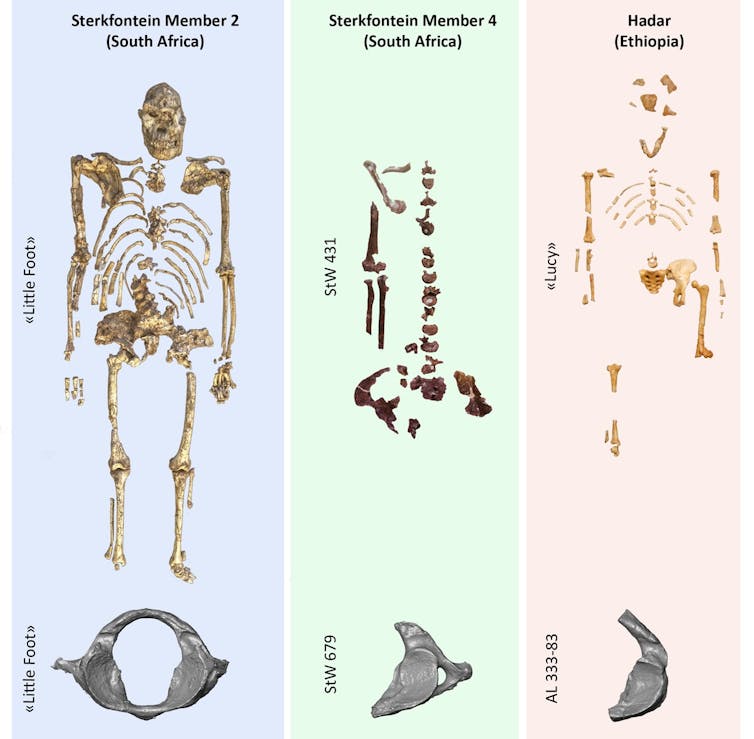
The atlas of Little Foot is similar to the one of the Australopithecus specimen from Ethiopia. The additional specimen from South Africa, which comes from the geologically younger deposits of Sterkfontein, is more human-like. These observations could indicate that at least some earlier species of Australopithecus may have spent much more time in trees than the later representatives of the genus.
Finally, our estimation of blood flow supplying Little Foot鈥檚 brain shows that the energetic costs of 础耻蝉迟谤补濒辞辫颈迟丑别肠耻蝉鈥� brain were lower than those estimated in modern humans. This could be due to 础耻蝉迟谤补濒辞辫颈迟丑别肠耻蝉鈥� relatively small brain, a diet that incorporated less meat (and so provided less energy), or because other organs required more energy.
This confirms the late emergence of the human-like brain metabolism that suggested.
More to come
There is still more work to be done on Little Foot鈥檚 skeleton 鈥� we are planning more studies using the various tools offered by 鈥渧irtual paleoanthropology鈥�. These studies and others will help us to shed more light on a crucial part of human ancestory鈥檚 family tree.
, Postdoctoral fellow,
This article is republished from under a Creative Commons license. Read the .